BILL SCHICK
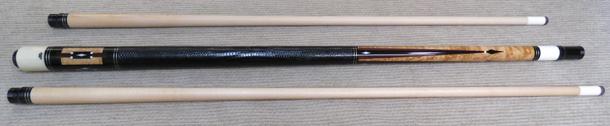
FOUR POINT EBONY, MAPLE & IVORY
1998 CLASSIC
|
Presented here is a rare bird - a vintage cue by the late, great Hall of Fame cuemaker Bill Schick in unused condition. Not new in terms of years, but still unplayed as far as I can tell.
|
By Bill's standards, this one is far from simple, but on the other hand not as complex or ornate as many. It falls somewhere in the middle. It's a nice design and an attractive cue. And it's a Schick, which means it's loaded up with ivory. I don't think any other cuemaker liked building with ivory as much as Bill did.
|
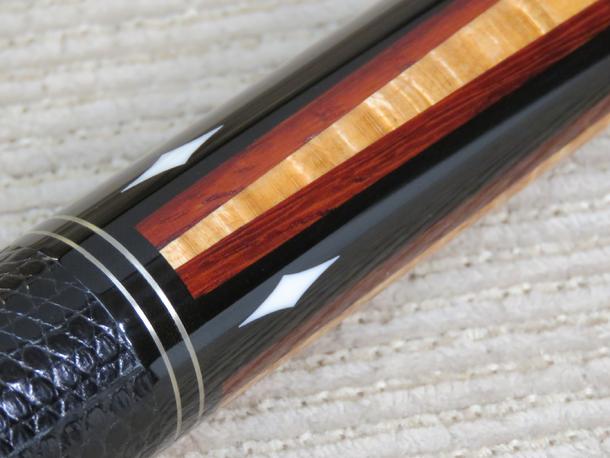
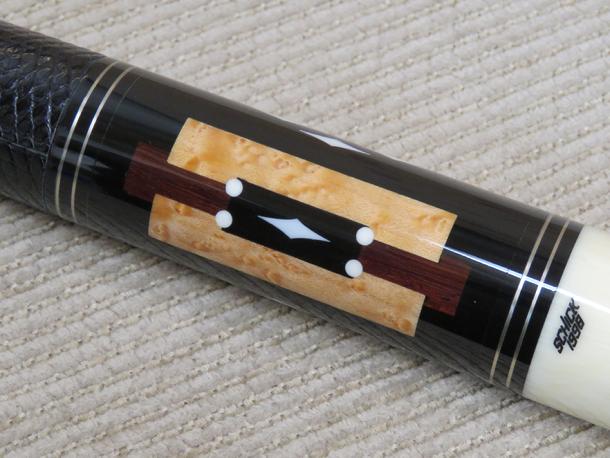
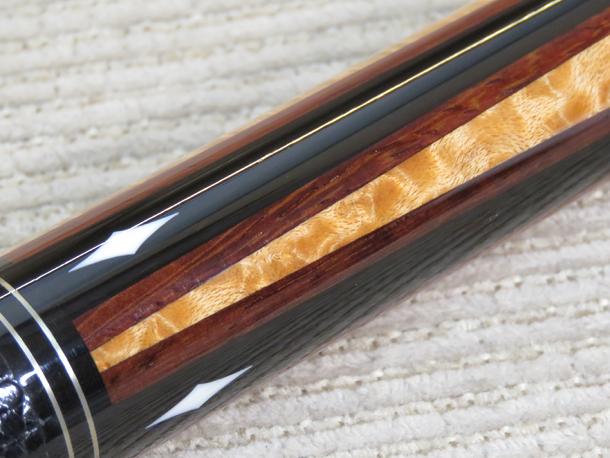
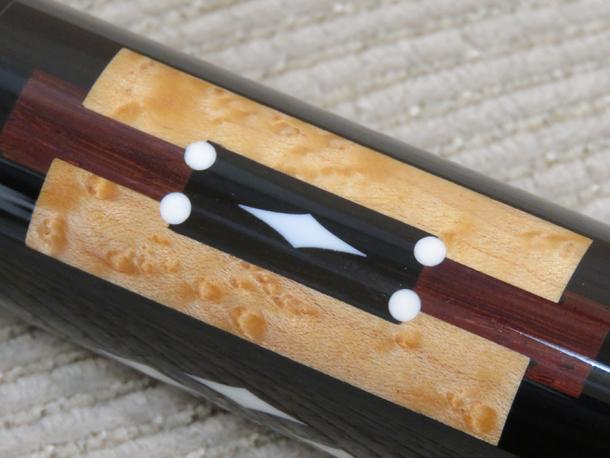
The introduction of a third wood in this design makes it special. It's unusual to use several types of wood in a cue, but in this case the third wood (the detail wood) is as nearly important as the ebony and the maple. When I first saw the cue I thought the wood was purpleheart, but on closer inspection I think it's cocobolo, even though it has an unusual tint to it.
|
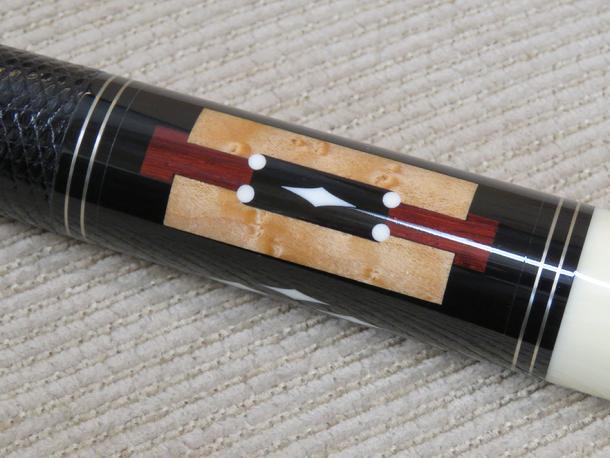
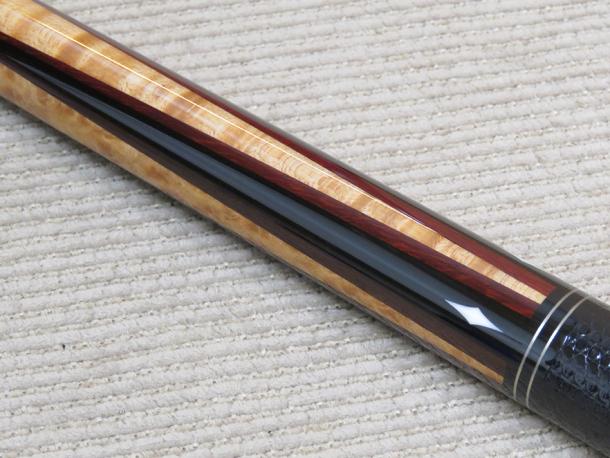
By using the cocobolo not only in the small rectangles in the butt sleeve, but also as a wide veneer outlining the points, it takes a prominent role in the overall impression the cue makes.
|
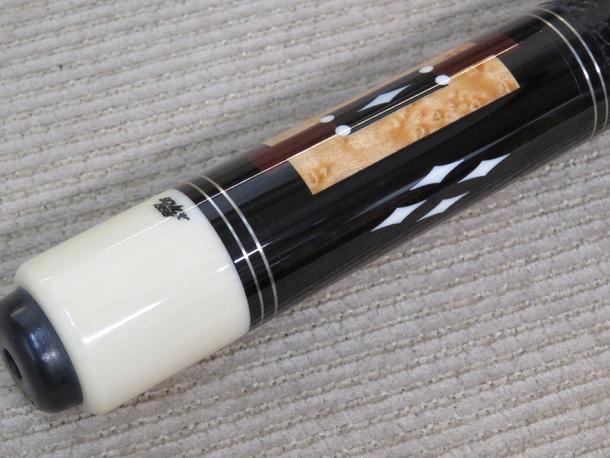
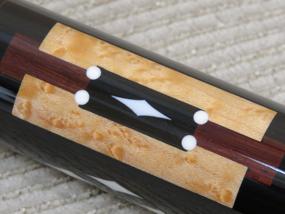
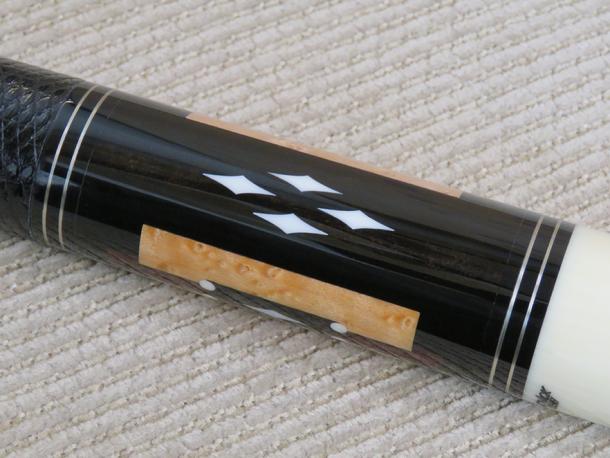
There's something almost like an optical illusion about the way Bill organized the series of rectangles and dots in the butt sleeve. It's an interesting design and one that is very unique - I can't recall ever seeing the design used anywhere else in a cue.
|
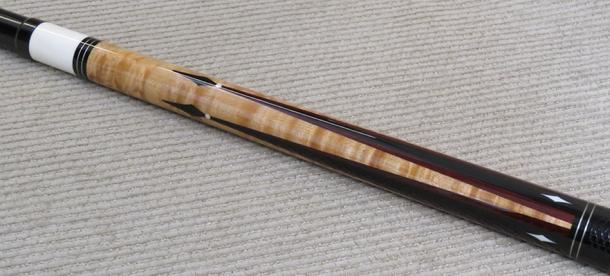
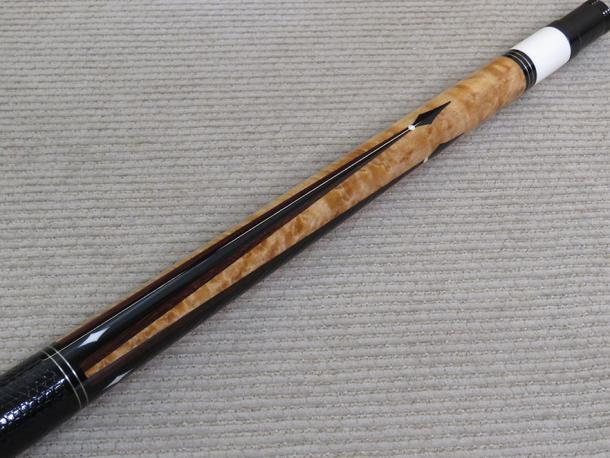
Bill liked to tip the points in his cues with large spearheads. His work often leaned toward the bold, rather than delicate. He frequently preferred large inlays rather than small, delicate ones.
|
The old time cuemakers often used spearheads or dots to cover the tips of their points because the points weren't even, and they could hide the sometimes poor quality of their work. As the skills have improved, cuemakers don't do it as often, indicating their pride in the precision of their points. However, even after Bill became one of the best, he still liked topping his points with an additional inlay. He wasn't hiding anything - he just liked the look of it.
|
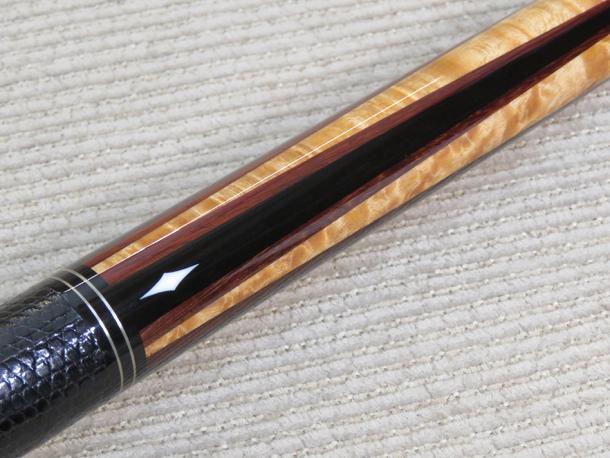
The maple in this forearm has nice figure, with lots of birdseye and curls.
|
The handle is wrapped with a supple black ring-tailed lizard leather that adds to the sheer class of this stick.
|
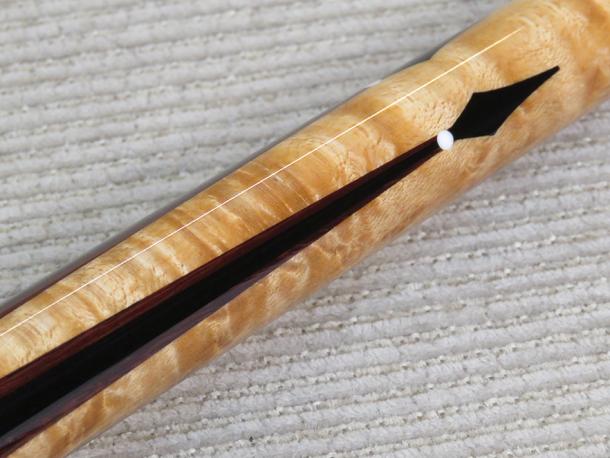
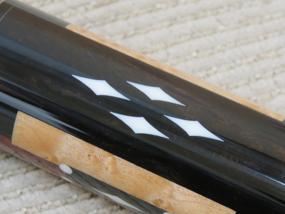
Something else that's a bit unusual about this cue is that the spearheads topping the points is in ebony, rather than the contrasting white spearheads we're used to seeing.
|
|
He uses a small dot of ivory at the top of each point, making the transition to the ebony spearhead. It's another unique twist to this design. It really complements the white ivory joint.
|
I love the way the look of the butt sleeve looks radically different as you turn it 90 degrees.
|
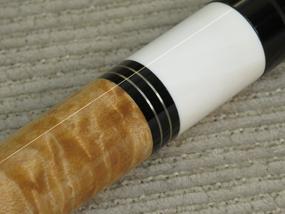
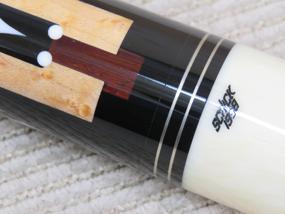
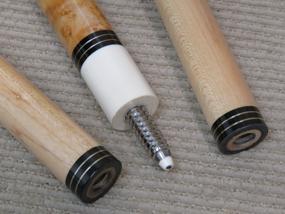
He adds a stylish set of double silver rings on either side of an ebony ring, and uses them at all locations - at the butt cap, below and above the handle, at the joint and on the ring collars of the matching shafts.
|
|
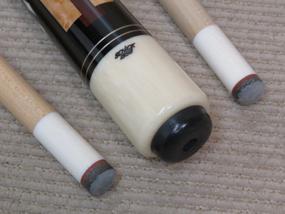
And, of course, he builds it with an ivory butt cap with his name and the year of the build, "Schick 1998."
|
This is a very pretty cue that plays crisp and stiff like all of Bill's cues. And in 1998 when it was built it was very fancy by his standards at the time.
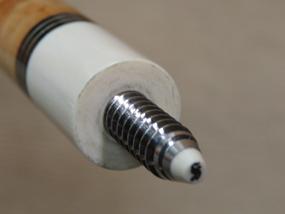
It is made with a 3/8 X 10 steel pin in a flat-faced joint. It comes with two of Bill's top quality, tight-grained old growth Canadian maple with long, 1-1/4 inch ivory ferrules. Bill loved to use that ivory!
It weighs either 19. or 19.3 ounces depending on which shaft is used (15.3, 3.9, 4.0), and it is 58 inches long.
|
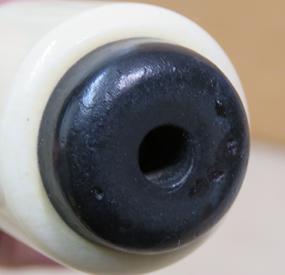
And, a couple of additional details are well-worth mentioning. As he did with most of his higher end cues, he tipped the joint pin with a small piece of ivory with a stylized "S" engraved on the end. Also, you can see the joint isn't just an ivory sleeve over wood. It's a solid ivory joint, which Bill loved to use. And finally, just like everything else on this stick, the bumper is still original.
|
As mentioned earlier, this cue is in excellent condition, unplayed, and a rare find. I believe it is very fairly priced at $6500 plus shipping.
|
|